
[ad_1]
- New York City is getting a vast, unique electric-vehicle charging hub that will run on lithium-ion batteries.
- Charging company XCharge and electrification contractor Energy Plus say the 44-stall station will open in Brooklyn next quarter.
- The station could reduce the cost of charging for EV drivers during peak hours.
The American auto industry is in the middle of a sweeping transformation, one that goes far beyond just selling more electric cars.
The infrastructure required to support battery-powered vehicles is expanding rapidly too, and the technology underpinning it is evolving just as fast. One of the more notable developments is the rise of large EV charging stations powered by batteries that can boost power and supplement the grid.
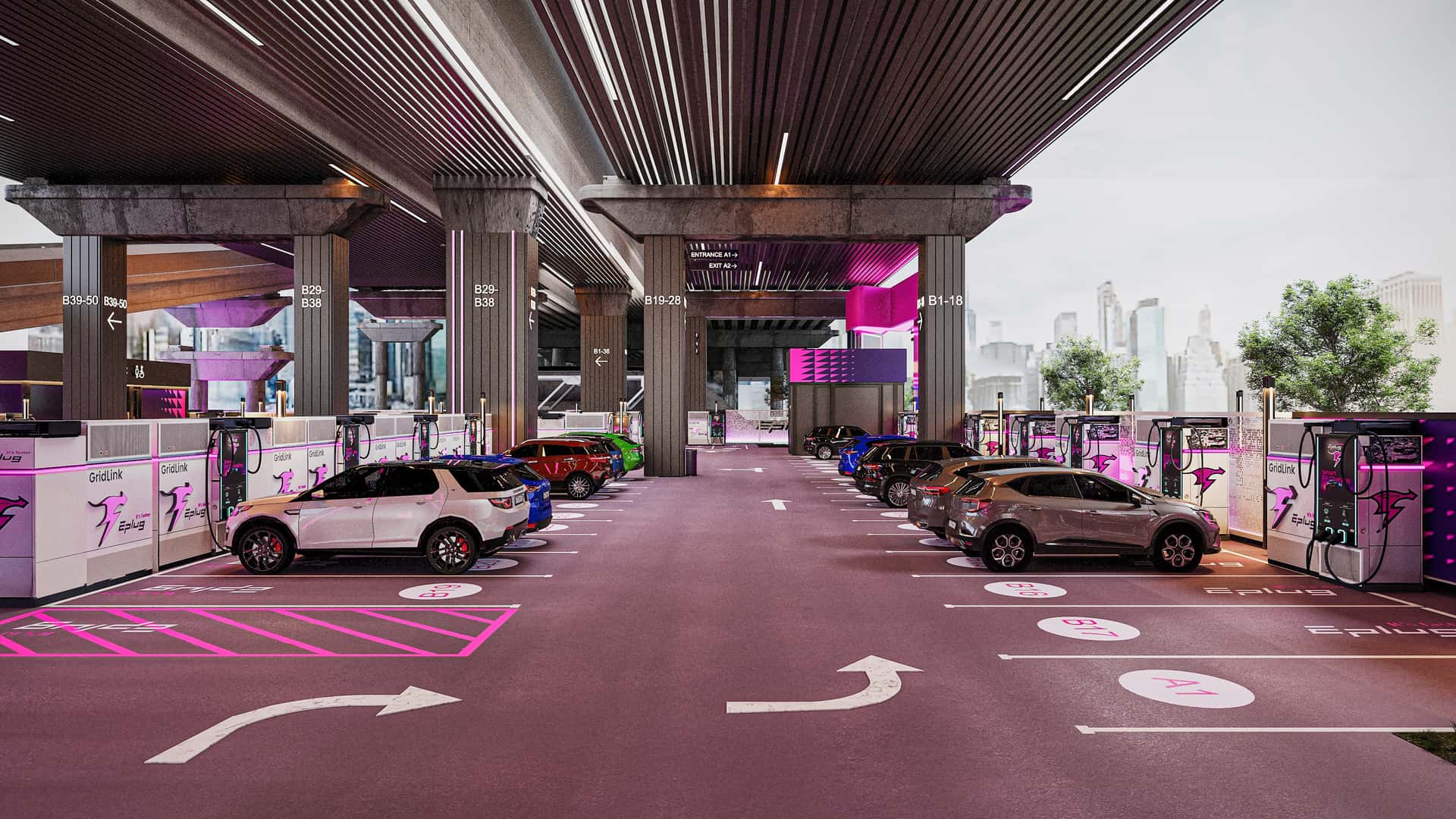
German EV charging company XCharge and New York-based contractor Energy Plus announced on Wednesday plans to open what they say will be the largest battery-powered EV charging hub on the East Coast. The station is set to go online in the second quarter of this year in Brooklyn’s Williamsburg neighborhood, featuring 44 chargers serving 88 parking spaces.

Rendering of the XCharge EV charging station in New York City.
Photo by: XCharge
Each charger will be able to dispense up to 300 kilowatts of power. That’s higher than most Tesla Superchargers today, which peak at 250 kW and just shy of Electrify America’s 350 kW units.
What sets this site apart, though, isn’t charging speeds. It’s how the electricity is stored and deployed. Typical fast chargers draw power directly from the local electricity grid in real time. A battery-backed charging hub, by contrast, adds an on-site buffer in the form of large containers filled with lithium-ion cells. Electricity is drawn from the grid during off-peak hours (when energy is cheaper), stored in those batteries, and then dispensed to EVs when drivers plug in.
Several charging stations in the U.S. already rely on on-site energy storage systems, like Tesla’s gigantic off-grid Supercharger station in Lost Hills, California, which combines a solar farm with an ESS microgrid.
The XCharge site in New York City works on a similar principle, but the charging stalls function as mini microgrids, with the battery and charger housed together in a single unit. In other words, each charger has its own dedicated battery storage unit. XCharge calls these units GridLink. Each charging stall includes two fast-charging cables, an information display and a stationary energy storage battery.
Photo by: XCharge
“There are several benefits of a battery-backed EV charging hub versus a regular one,” Aatish Patel, co-founder and president of XCharge North America, told InsideEVs in an email. “GridLink puts less strain on the grid during peak demand hours because it has stored energy from off-peak times,” he added.
The 44 GridLink chargers will deliver up to 9.46 megawatt-hours of electricity, with each container housing 215 kilowatt-hours of battery storage capacity. That’s enough stored energy to charge as many as 126 EVs from empty to full, assuming an average battery pack size of 75 kWh.
Photo by: XCharge
This approach could have real-world implications for charging costs. Public fast-charging prices during rush hour are often steep in major cities, sometimes even exceeding the cost of refueling a gasoline car. At least in theory, a battery-powered setup like this can soften peak demand surcharges by drawing electricity when it’s cheaper and storing it ahead of time. That stored energy can then be delivered to drivers at potentially lower rates.
XCharge hasn’t said exactly how much cheaper charging EVs at this site will be. But fast charging in the New York City metro area is expensive. Over the past year, I’ve driven more than a dozen EVs in the Tri-State area and paid as much as $0.65 per kilowatt-hour at Electrify America stations, and around $0.55/kWh at Tesla Superchargers in Brooklyn and Revel stations in Manhattan.
On smaller EVs, the total cost of a single charging session seems reasonable, but on larger EVs with 100-plus-kWh batteries, those rates sting, with the total bill for a 10-80% charge often exceeding $60-70. If XCharge can beat those prices, the Brooklyn hub could become popular among price-sensitive drivers, especially the thousands of rideshare drivers who have gone electric due to new Taxi and Limousine Commission (TLC) rules.
The GridLink units also support bidirectional charging, meaning they can send stored power back to the grid during emergencies to help ease the strain. They can essentially function as stationary energy storage systems that are increasingly being deployed across the U.S. to help utilities manage rising electricity demand from things like energy-hungry AI data centers.
So even if EV sales in the U.S. remain uneven due to constantly changing policies, gains across the broader electrification ecosystem should ensure that charging infrastructure is ready when EV demand rebounds in the future.
Have a tip? Contact the author: suvrat.kothari@Ev Authority.com
[ad_2]
