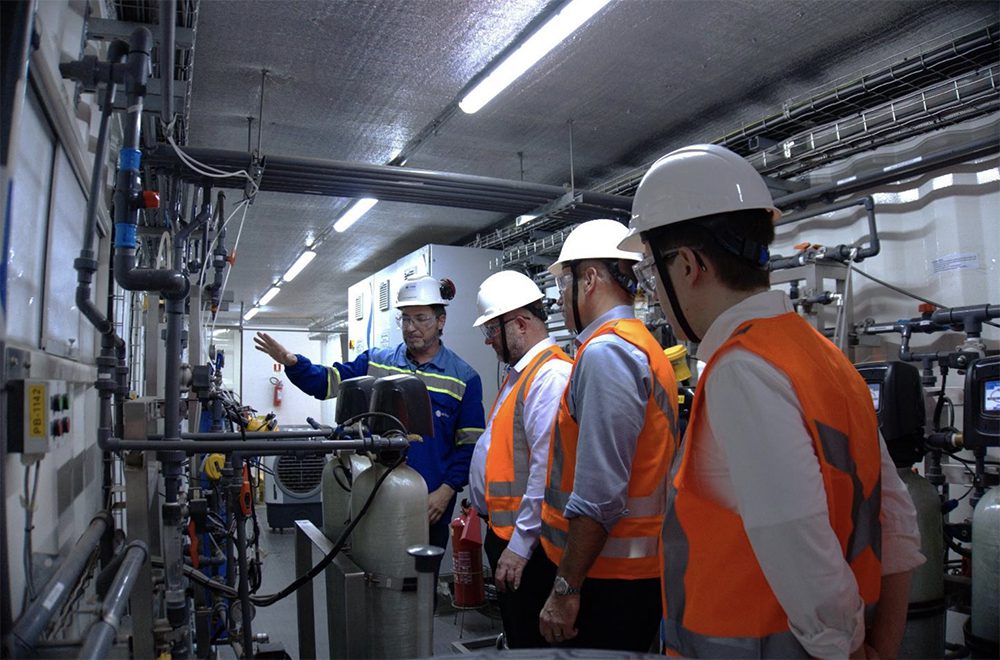
Aclara Resources strengthened its relationship with Germany-based Vacuumschmelze (VAC) and its subsidiary eVAC Magnetics during a recent visit to its Carina Project pilot plant facility.
The companies are working together to design and implement a fully integrated rare earth supply chain for the production of permanent magnets.
Aclara’s pilot operation at the Carina Project in Goiás, Brazil has produced approximately 150 kg of high-purity mixed rare earth carbonate (MREC) using the company’s Circular Mineral Harvesting process.
The MREC will be further refined into individual rare earth oxides at Alara’s recently-announced separation facility in Louisiana, which is scheduled for completion by the fourth quarter of 2027. The company plans to develop metal and alloy processing capabilities at the same site to convert the oxides into the specialized alloys required for magnet production.
Aclara and VAC discussed product specifications, process scalability and integration pathways with VAC’s magnet manufacturing operations, including the eVAC magnet production facility that opened this year in South Carolina.
“VAC’s visit to our pilot facilities represents another tangible step toward realizing our shared vision of an integrated, transparent and sustainable mine-to-magnets supply chain,” said Jose Palma, Executive Vice President of Aclara. “Aclara is uniquely positioned to supply significant quantities of heavy rare earth elements by mid-2028, perfectly aligning with VAC’s growth plans in the United States and globally.”
The companies signed a memorandum of understanding in 2024, which formalized their intent to jointly develop a mine-to-magnet supply chain for manufacturers in the EV, renewable energy, robotics and advanced manufacturing sectors.
Aclara and VAC agreed to collaborate technically and commercially to establish a cost-effective and geopolitically independent supply chain for rare earth permanent magnets, and to jointly engage with automakers and industrial customers to present a solution for securing permanent magnets produced outside Asia. To that end, the companies agreed to align their product specifications and cost models to ensure that Aclara’s rare earth oxides, alloys and magnets will meet VAC’s magnetic manufacturing requirements.
Aclara is developing two ionic clay deposits rich in heavy rare earths in Brazil and Chile as well as the separation plant in Louisiana. It has also formed a metals and alloys joint venture with CAP to produce high-performance rare earth alloys, a key feedstock for VAC’s permanent magnet production lines.
Source: Aclara