
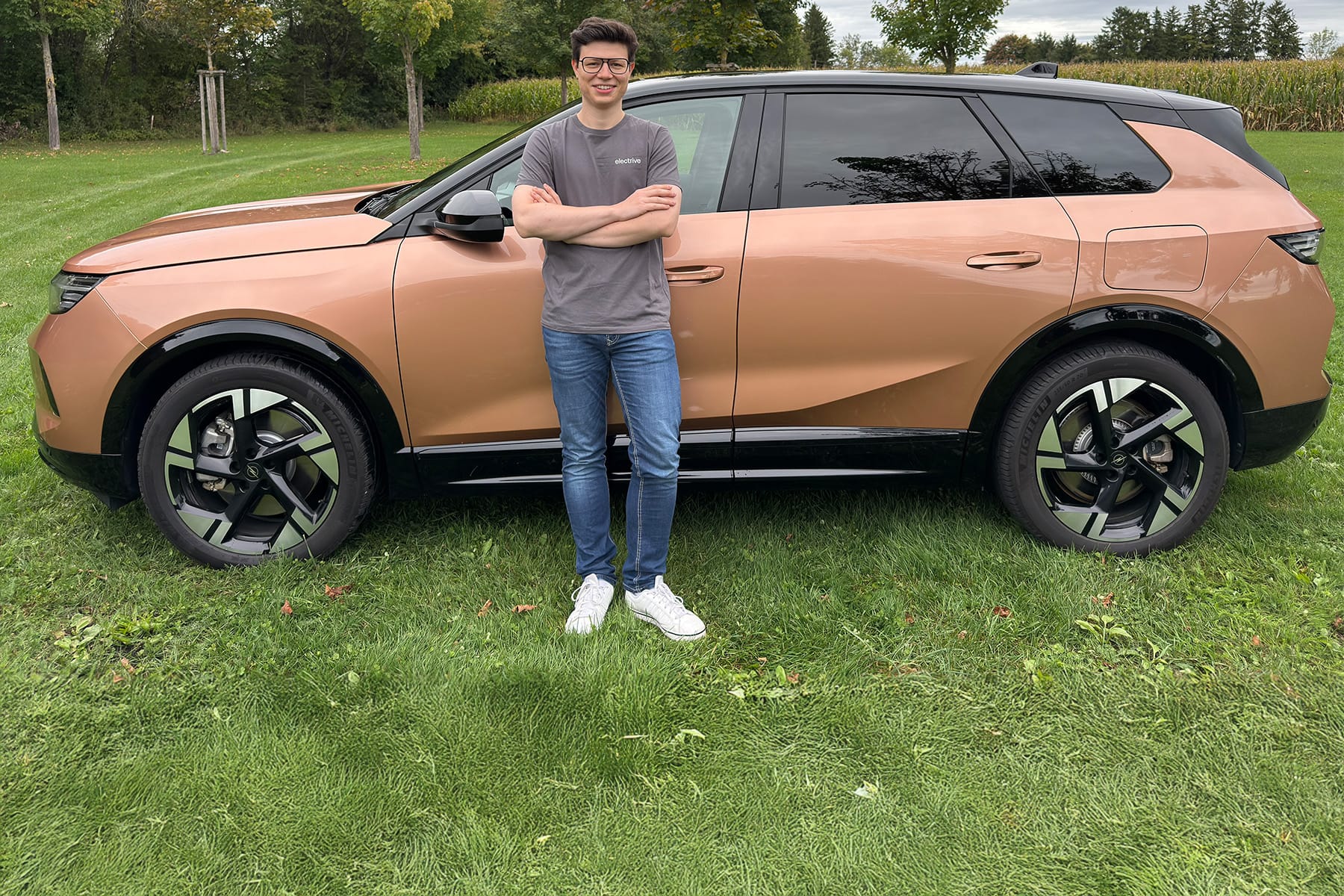
At the launch of the Grandland, Opel proudly emphasised that its entire portfolio is now available in electric form. However, the word ‘now’ reveals a key detail: none of these vehicles was designed from the outset as a pure electric car. Instead, all are also available with internal combustion engines; a compromise we will explore in more detail later.
A contemporary SUV
The Grandland’s exterior design attracts little attention, but it avoids standing out in a negative way. It blends seamlessly into the crowd of other SUVs. The base paint colour, ‘Impact Copper’, suits it well, ensuring it still catches the eye. The lighting follows current trends, with continuous light strips at the front and rear, and the front features an illuminated brand logo.
At the rear, Opel relies solely on letters, embedding ‘OPEL’ into the light strip. The model designation is stamped prominently into the metal. The only indication of the powertrain is the E licence plate. The small round ‘e’, which older Opel battery-electric vehicles (BEVs) featured as a hint, is no longer present on the Grandland.
Premium ambience with ‘Luxury Trinity’
Compared to earlier models, and especially to Opel’s own vehicles in lower segments, the cockpit has seen a significant upgrade. A stylish head-up display, solid craftsmanship, and high-quality seats with a “luxury trinity” of seat heating, ventilation, and massage functions make passengers feel truly welcome. The seat heating is also available for the two outer rear seats, while ventilation and massage are limited to the front. Opel has incorporated a touch of luxury here; in this price range, few manufacturers even offer the option of massage seats. The use of artificial leather and fabric upholstery in the line of sight further enhances the premium feel.
The central display defies the trend of ever-larger, carelessly mounted tablets in the centre console. Instead, a slim, elongated screen sits elegantly below the driver’s line of sight. The operating concept is complemented by tactile buttons for the air conditioning and volume control, as well as solid steering wheel controls. The steering wheel design, however, is a matter of debate, particularly concerning the flat logo, which has unfortunately become an industry trend likely to appeal only to the finance department.
A neat solution is the frosted glass compartment in the centre console for the inductive smartphone charging tray. The opaque screen prevents distraction, while a green LED always indicates whether it is actually charging.
A compromise in hardware and software
Unfortunately, the interior also reveals a key truth: the vehicle is essentially a converted internal combustion engine model: a compromise rather than a car designed from the ground up as a battery-electric vehicle. Despite its generous height, Opel has not managed to provide comfortable thigh support for rear passengers, leaving their legs positioned too high. This is an area where improvements could be made, especially in an SUV measuring 1.66 metres in height.
For someone 1.80 metres tall, the fully extended headrest presses uncomfortably on the neck, a position that is not only uncomfortable for daily use but also dangerous in a crash. Other details, such as the missing front boot (frunk) or various software quirks, constantly remind you that the Grandland was not truly designed as a battery-electric vehicle.
The charging flap can only be opened when the “ignition” is switched off—turning off all interior functions in the process. You can then open the overly large cover and start charging, only to realise upon returning to the car that it has gone cold because the heating is off—naturally, as the “ignition” is off. So, you press the start-stop button again to warm up, only to find that with the ignition on, you can no longer see whether the car is still charging—or, more importantly, how fast. Incidentally, the charging rate is never displayed in kilowatts, only in kilometres per hour. These are not even the only charging issues, but more on that later.
One feature that deserves praise, however, is the spacious boot, which offers between 550 and 1,645 litres of storage. It includes two clever additional features. The rear bench can be folded down not only in a 60:40 split but also in three separate sections, allowing each seat to be adjusted individually. Instead of a tiny ski hatch, this creates a large opening that can easily accommodate snowboards. The double-loading floor locks into place when lifted, making it easy to remove the charging cable with both hands from the underfloor compartment.
Good user interface, mediocre navigation system
Opel has delivered an almost perfect infotainment system. The head-up display is a joy to use, as it shows a large, clear navigation map. Additionally, you can scroll through the current music playlist and call history directly from the steering wheel. The content displayed on the head-up display and instrument cluster can be freely configured to suit your preferences. The menu navigation is logically structured and runs smoothly. The navigation system includes a practical route planner that provides good charging suggestions and accurately predicts the battery level upon arrival—commendable! This was not always the case with Stellantis.
However, the navigation system is not perfect. It has a tendency to take detours and, with stubborn persistence, occasionally insists on diverting to country roads when motorway delays exceed ten seconds. Away from the motorway, the system acts more like a tourist guide than a purposeful navigator. On routes we had not previously travelled, we discovered Munich and its surroundings in entirely new ways.
This is not necessarily a dealbreaker, as more and more drivers are opting for Apple CarPlay or Android Auto anyway. These run wirelessly but, unfortunately, do not fit perfectly into the format of the very wide yet low central display.
Efficiency Top, Charging a Flop
For its size, the Grandland’s energy consumption is surprisingly low. Our overall average was 20.5 kWh/100 km, recorded during autumnally cool temperatures and often with a sporty driving style, which is perfectly acceptable. In slow-moving traffic (with a top speed of 120 kph and an average of 100 kph), it can be driven as efficiently as 17.8 kWh/100 km, while in urban settings, consumption drops to a slender 14 kWh/100 km. If you fully utilise the maximum speed of 170 km/h, consumption rises to 35.1 kWh/100 km, at which point you will wish for the larger battery. The test vehicle was equipped with only the 73 kWh battery. This is sufficient for urban driving, country roads, and normal motorway cruising. However, those who prefer to drive more briskly will benefit from the 97 kWh variant.
With the “small” battery and our consumption figures, the minimum range is 200 kilometres, while the maximum extends to 520 kilometres. In everyday use, a realistic range of 400 kilometres is achievable. With this efficiency, the Grandland has no reason to hide, especially as summer conditions are likely to improve these figures further. Additionally, a larger battery has already been introduced for those who cover long distances.
When it comes to charging, however, there is unfortunately little to praise. The charging performance does not do justice to the vehicle’s price class. The standard charging window from 10 to 80 per cent takes a leisurely 35 to 40 minutes—far too slow for 2025. Preconditioning the battery also seems suboptimal, as the charging power drops significantly earlier in colder temperatures. In good weather, the 160 kW peak power is maintained until just over 50 per cent, but in lower temperatures, the power is already reduced by 30 per cent.
Frequent charging interruptions at fast chargers add an extra layer of frustration—something we have not experienced to this extent in any other current electric vehicle. This issue is compounded by the fact that the car remains completely silent when the charging process is interrupted. To recap: to keep the interior warm at the fast charger, we leave the “ignition” on. However, a charging screen with information is only displayed when the “ignition” is off. With the “ignition” on, the car stubbornly refuses to provide any information on whether it is still charging, and the only vague indication is the increasing charge level.
Luxury class comfort
At least the front-wheel-drive model we tested is not a sports car, but a family vehicle does not need to be. What truly matters, it delivers exceptionally well: cornering, noise levels, and motorway driving, there is nothing to criticise. Even at high speeds, the Grandland drives comfortably and confidently. The electronically limited top speed of 170 kph does not feel like it, thanks to stable road grip, precise steering, and a pleasantly quiet interior.
The recuperation level can be adjusted using paddles on the steering wheel, but one-pedal driving and a hold function are not available. At night, we appreciated the matrix LED lights, which do not need to hide behind German premium competitors. They provide bright illumination without dazzling other road users.
The driver assistance systems, however, leave a more ambivalent impression. Lane and distance are kept well, but that is about it. Lane changes, let alone automatic ones? No. Emergency corridor formation? No. Even maintaining distance in traffic does not work smoothly, as the system switches too jerkily and hectically between acceleration and braking.
On the positive side, the lane-keeping assistant works flawlessly up to the vehicle’s top speed and keeps the car excellently in lane even at high speeds. The capacitive hands-off detection on the steering wheel also makes assisted driving more comfortable.
Conclusion: the leasing rate must be right
The Opel Grandland does many things well. The cockpit is appealing, the exterior design is modern, the seats are comfortable, and there is plenty of space. However, it stumbles in key areas such as the navigation system and charging performance. All this does not make it a bad car, but it is not truly outstanding either. Purchasing it at the list price is not advisable, as there are now simply too many significantly better vehicles available in this price range.
For the same money, other manufacturers offer all-wheel drive, larger batteries, or significantly shorter charging times; some even combine all three. However, the Grandland becomes far more attractive as a leasing option, where Opel is currently offering genuinely competitive rates. If you can live with the mentioned shortcomings, a good leasing deal is certainly worth considering.
