
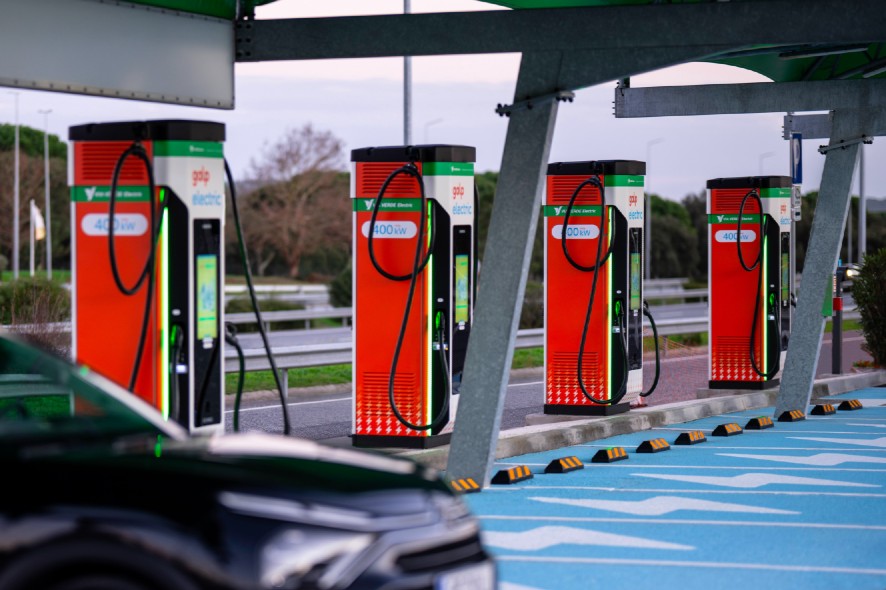
Galp’s new high-speed charging points offer charging capacities of up to 400 kW and are primarily designed to support long-distance travel on the key north-south corridor between Lisbon and Faro. However, the Portuguese energy company has not provided details on the number of charging points per location or their individual charging capacities.
In return, the company highlights several features of its charging sites. These include a range of services, night-time lighting, sheltered charging areas, and barrier-free access lanes.
The 48 high-speed charging points represent only the first phase of an investment plan, under which Galp aims to deploy high-performance charging infrastructure along Portugal’s two most important motorways, the A1 and the A2. By the end of the first quarter, an additional 48 high-speed charging points are set to be installed at four charging hubs along the A1. In total, this would bring 96 high-power charging (HPC) points into operation along both routes.
Upon completion of the project, the installed charging capacity along the two motorways is expected to reach around 20 megawatts. At full utilisation of all charging points, this would equate to approximately 200 kW per charging point.
Since 2020, the company has doubled its number of charging points each year. By the end of the third quarter of 2025, Galp already operated 8,500 installed charging points across Portugal and Spain. Of these, 20 percent were high-speed or ultra-high-speed charging points. The inauguration of the largest Iberian charging hub, featuring 116 charging points at the Intú Xanadu shopping centre in Madrid, marked one of the milestones in the development of the public Iberian charging network by 2025, according to Galp. In the last quarter of 2025, the company tripled its number of charging points at the Alcácer do Sal and Aljustrel sites by adding 48 high-speed charging points.
However, the development of private charging solutions is also a key growth driver for Galp in this sector, as the Portuguese company emphasises. Galp positions itself as ‘a relevant partner in the decarbonisation of vehicle fleets for large companies in key economic sectors’. Recent projects include implementations for Novobanco, Banco Santander Totta, Bosch, and SIBS.
The energy company is also focusing on electric heavy-duty transport. A highlight in the private sector was the installation of the first 400 kW high-speed charger for heavy commercial vehicles at TJA – Transportes J. Amaral. This project supports Portugal’s first 100 percent battery-electric freight transport route, according to Galp.
theportugalnews.com, galp.com (in Portuguese)
