
Chinese battery giant CATL is exploring an ocean of opportunities. As Michael Barnard reports in CleanTechnica, the company’s batteries and energy management systems are already operating in roughly 900 ships and vessels. This isn’t just a measure of CATL’s dominance, but an indication that maritime decarbonization is well underway—based on existing electrification technology.
“Shipping is conservative for structural reasons tied to safety, long asset lifetimes, and unforgiving certification regimes, so deployment at this scale signals that electrification is no longer a pilot exercise but operating infrastructure,” writes Barnard.
Mr. Barnard is an eloquent debunker of arguments for the “alternative fuels” promoted by the “anything but EVs” crowd. While acknowledging that “long-haul ocean vessels face genuine energy density constraints that batteries alone cannot solve today,” he points out that electrification has been quietly advancing in the maritime transport applications where it actually works today.
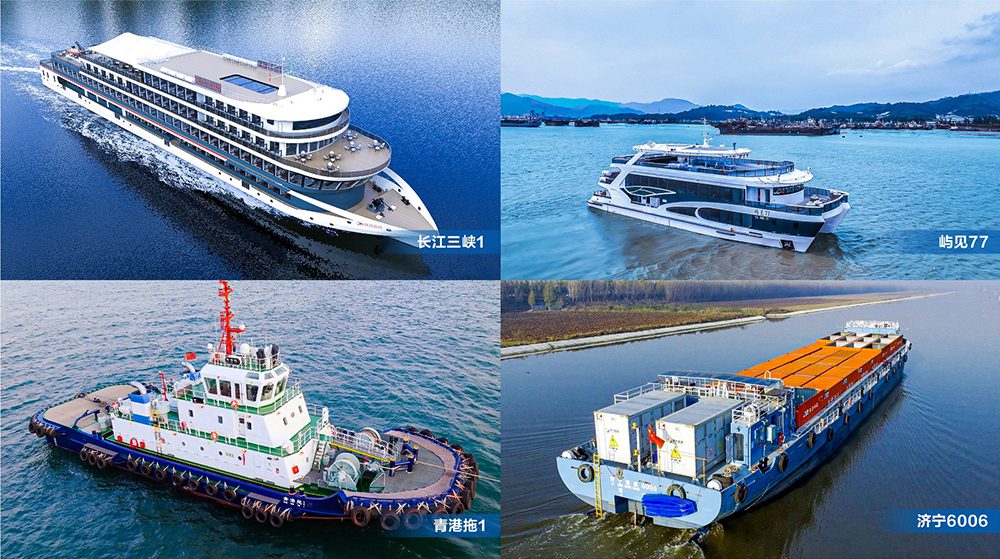
Among the vessels powered by CATL’s systems: Changjiangsanxia 1, a 100-meter all-electric inland passenger ship carrying more than 1,000 passengers daily on the Yangtze River in the Three Gorges region; the Yujian 77 electric passenger vessel, which operates on short sea routes; hybrid tugboats such as Qinggang Tug 1, which operate in urban harbor environments; and the Jining 6006 electric vessel, which hauls freight on the Beijing-Hangzhou Grand Canal using containerized battery swapping.
CATL’s interest in maritime electrification extends beyond supplying batteries. Its marine subsidiary Contemporary Amperex Electric Vessel (CAEV) recently unveiled a Ship-Shore-Cloud electric vessel solution that integrates the full cargo-handling stack. Onboard, CATL combines batteries, power electronics, propulsion integration and control systems. Onshore, it provides charging and battery swapping infrastructure. In cyberspace, it offers software systems that provide fleet operators with continuous monitoring, scheduling and maintenance planning across fleets.
Mr. Barnard predicts that most of the electrification action over the next two decades will be seen in inland shipping, ports, and short sea routes, which can be electrified using today’s technology. “Inland waterways and coastal services have constrained ranges, centralized charging opportunities, and fixed schedules, all of which favor battery electric propulsion. Ports, meanwhile, are stationary energy consumers that can anchor grid upgrades, renewable integration and storage.”
CATL is not the only Chinese battery manufacturer active in the maritime space: BYD has supplied batteries and complete electric propulsion systems for ferries and workboats; EVE Energy is supplying LFP cells and packs for electric and hybrid vessels; and CALB and Gotion High-Tech are supplying cells and modules used in marine energy storage systems.
Meanwhile in the US, “federal policy has actively attacked or undermined progress,” Barnard reports. “By scuttling decarbonization measures at the International Maritime Organization, the United States has injected uncertainty into a sector that depends on long-lived assets and stable standards. The United States has a lagging battery manufacturing sector compared with China, and no meaningful commercial shipbuilding industry.”
“CATL is positioning itself to become the dominant global player in port and shipping electrification, combining manufacturing scale, certified marine technology, integrated service models and anchor partnerships with operators such as Maersk,” Barnard concludes. “That strategy is reinforced by national Chinese policies that emphasize electrifying inland shipping and ports using technologies that are already commercially viable, rather than deferring action in favor of speculative fuel pathways.”
Source: CleanTechnica
