
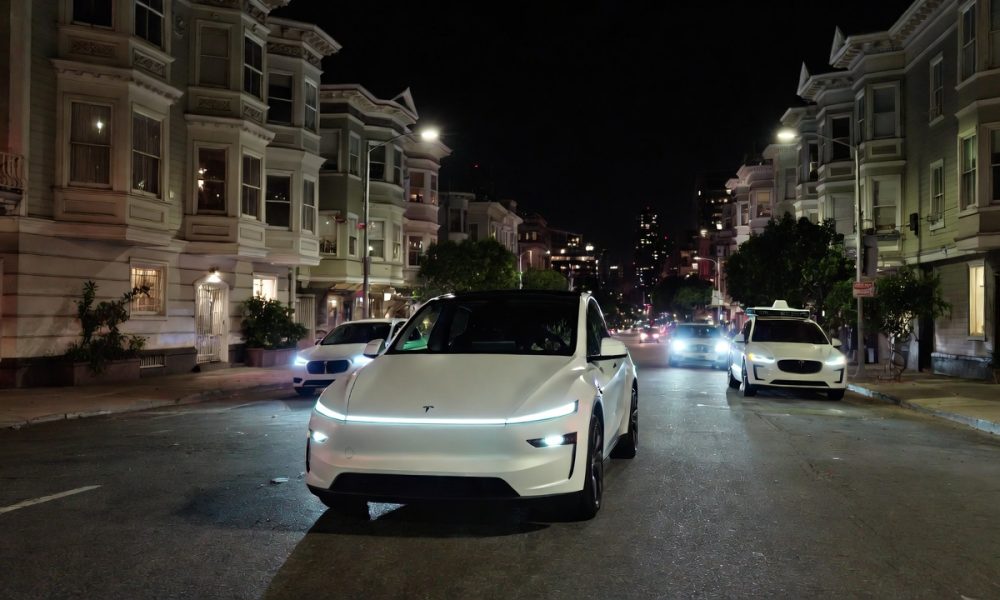
NVIDIA CEO Jensen Huang has offered high praise for Tesla’s Full Self-Driving (FSD) system during a Q&A at CES 2026, calling it “world-class” and “state-of-the-art” in design, training, and performance.
More importantly, he also shared some insights about the key differences between FSD and Nvidia’s recently announced Alpamayo system.
Jensen Huang’s praise for Tesla FSD
Nvidia made headlines at CES following its announcement of Alpamayo, which uses artificial intelligence to accelerate the development of autonomous driving solutions. Due to its focus on AI, many started speculating that Alpamayo would be a direct rival to FSD. This was somewhat addressed by Elon Musk, who predicted that “they will find that it’s easy to get to 99% and then super hard to solve the long tail of the distribution.”
During his Q&A, Nvidia CEO Jensen Huang was asked about the difference between FSD and Alpamayo. His response was extensive:
“Tesla’s FSD stack is completely world-class. They’ve been working on it for quite some time. It’s world-class not only in the number of miles it’s accumulated, but in the way it’s designed, the way they do training, data collection, curation, synthetic data generation, and all of their simulation technologies.
“Of course, the latest generation is end-to-end Full Self-Driving—meaning it’s one large model trained end to end. And so… Elon’s AD system is, in every way, 100% state-of-the-art. I’m really quite impressed by the technology. I have it, and I drive it in our house, and it works incredibly well,” the Nvidia CEO said.
Nvidia’s platform approach vs Tesla’s integration
Huang also stated that Nvidia’s Alpamayo system was built around a fundamentally different philosophy from Tesla’s. Rather than developing self-driving cars itself, Nvidia supplies the full autonomous technology stack for other companies to use.
“Nvidia doesn’t build self-driving cars. We build the full stack so others can,” Huang said, explaining that Nvidia provides separate systems for training, simulation, and in-vehicle computing, all supported by shared software.
He added that customers can adopt as much or as little of the platform as they need, noting that Nvidia works across the industry, including with Tesla on training systems and companies like Waymo, XPeng, and Nuro on vehicle computing.
“So our system is really quite pervasive because we’re a technology platform provider. That’s the primary difference. There’s no question in our mind that, of the billion cars on the road today, in another 10 years’ time, hundreds of millions of them will have great autonomous capability. This is likely one of the largest, fastest-growing technology industries over the next decade.”
He also emphasized Nvidia’s open approach, saying the company open-sources its models and helps partners train their own systems. “We’re not a self-driving car company. We’re enabling the autonomous industry,” Huang said.
