

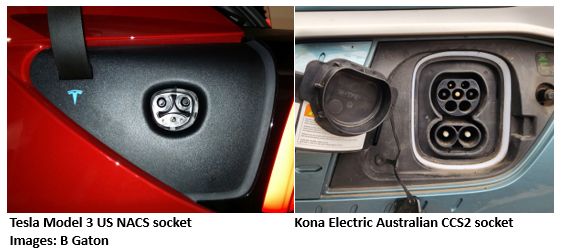

The North American Charging Standard (NACS) plug is a physically much smaller EV charge plug. Superficially, it would seem a better choice that the significantly bulkier CCS2 plug we use here in Australia.
As a result, if in my public talks I mention ‘The Plug War’ (and the fact that it is long over here with CCS2 the winner) I occasionally get the question “But is it over? Won’t we eventually get the NACS plug?”.
The short answer is ‘no, not ever’. The longer answer has to do with the varying types of AC supply systems around the world.


Don’t get me wrong: NACS is a beautifully elegant charge plug solution as its multi-purpose pins can swap between taking in two different AC voltages as well as DC.
However, it was designed for the peculiar 120/240V two phase electrical system found in North America and it does not translate to a three-phase electrical system, as found in most of the world.
Interestingly, before it was called NACS, the plug started out as a Tesla-only standard due to American Auto being dismissive of Elon Musk’s overtures to share it. (Perhaps because they thought Tesla wouldn’t last?!).
Elon had hoped to have them adopt his standard plug and cost-share the roll-out of a combined, single plug solution to public EV chargers.
Instead, the US and Canada ended up with a Tesla-only charger network rolling out first, plus a competing network of Type 1 based CCS1 DC chargers that was always playing catch-up in both size and reliability. (This was also when CHAdeMO lost the Plug War as the world outside of Japan and China opted for single socket charging solutions – be it NACS or CCS).
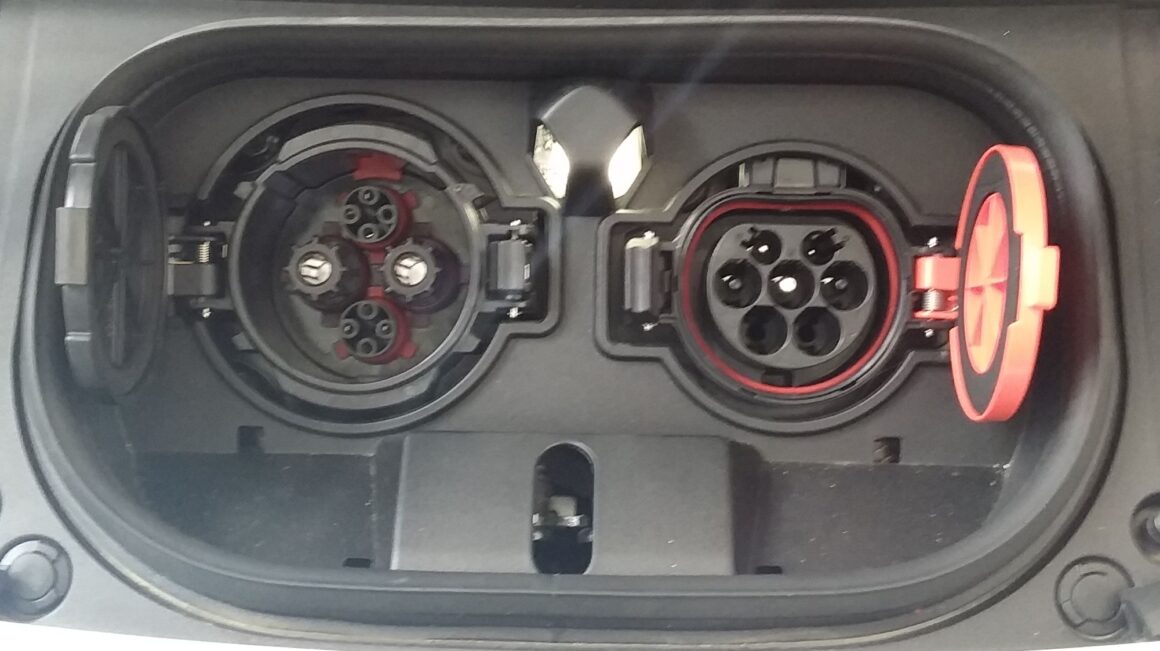

Australian ZE1 Leaf charge ports: CHAdeMO (DC) left, Type 2 (AC) right. Image: B Gaton.
As Tesla moved outside of the North American market to three-phase electricity countries, it adopted the emerging three-phase Type 2 standard in use there.
Unfortunately, not long after Tesla started selling EVs in Europe, that standard was modified to become CCS2 to add separate DC charge pins. As a result, Tesla was caught on-the-hop with the Models S and X having the Type 2 AC plug but a different approach to making the DC charge connection.
When Tesla introduced the Model 3 (and later the Y), it partly joined the CCS fold by fitting the CCS2 socket to them in 3 phase countries. Then, in 2021, Tesla completed the transition to CCS2 outside of North America by fitting CCS2 to the refreshed Models S and X.
As you can see, this left North America with a problem. Two big, but incompatible1 charger networks existed there, with the Tesla one having the edge in terms of size and reliability. Given there were lots of Teslas on the roads, along with an equally large Supercharger network, changing Tesla to CCS1 was out of the question.
North America’s Big Auto meanwhile were sticking to their guns with rolling out CCS1. However, new US entrants to the EV world started looking more pragmatically at the issue… and some decided to risk piggy-backing off the Tesla network reputation.
This was because Tesla were again offering their plug as a universal single/two-phase AC standard, now renamed ‘NACS’ – or North American Charging Standard.
As soon as a few of these new players adopted NACS, it seemed like a dam wall had burst and, as of today, virtually all the North American manufacturers and importers (big and small) have either started fitting (or announced plans to fit) NACS for the North American market.
This means that all the world’s major markets2 (except Japan) now have their own situation-specific standard plugs for EV charging. All cars in Europe and other three-phase markets have CCS2 (including any Teslas sold there), and North America now has NACS.
Now back to Japan. Japan is similar to the US in using an odd-ball two-phase AC system. Like the US used to, they still fit the Type 1 AC EV charging socket plus the separate, home-grown, CHAdeMO DC socket. Japan even stuck to CHAdeMO after the US went to the single phase based CCS1 and the rest of the world went to the 3-phase specific CCS2 version.
(This was because CHAdeMO does vehicle to grid whilst until recently CCS didn’t).
Now North America has dumped CCS1 in favour of NACS, Japan is the only major market left using the unique combo of Type 1 (for AC) and CHAdeMO (for DC). Given CHAdeMO is already dead outside of Japan, Type 1 is effectively so too now with the demise of CCS1 in North America.
Japan could perhaps have held back the tide by remaining solely Type 1 and CHAdeMO, but Tesla sales there are growing and Japanese Teslas are fitted with the NACS socket, along with a growing network of NACS Superchargers.
Now it seems Japan is about to have their NACS moment. In May this year Mazda announced they would adopt NACS for Japanese market EVs from 2027, and there are rumours that Honda may follow. In which case, the momentum would be building for the remaining Japanese manufacturers to switch.
Should that happen: all three of Type 1 AC, its cousin the CCS1 combo and CHAdeMO DC will finally be consigned to history.
Summing up:
The Plug War in Australia and all other three-phase markets was over some years ago with the adoption of CCS2. NACS now looks set to dominate in two-phase countries, but it will never be used elsewhere as it is a specific solution for single/two phase electrical systems, not three-phase countries like ours.
The final battle ground for The Plug War is therefore Japan, where a last-ditch action was being fought by Type 1 and CHAdeMO against CCS1. It seems though that a sneak attack by NACS looks like finishing all three off instead!
Of course, this will go back into the air (pardon the pun) when wireless charging is fully developed. Mind-you, charge sockets will still need to be fitted as a wireless charger won’t always be available.
In fact, my guess is that wireless chargers will eventually become the norm for public use (especially when autonomous vehicles appear) but the plug and socket will dominate for the home market as it will remain the cheapest and simplest solution.
Notes:
- There are adaptors for NACS to CCS and vice-versa, but they are reportedly somewhat unreliable.
- You may/may not have noticed I skipped one other major (in fact the world’s biggest) automotive market – China. China has its own unique combo of a Type 2 look-alike and a CHAdeMO look-alike. Both however are physically incompatible with Type 2 and CHAdeMO. Mind-you, being the good business people they are: for export markets, the Chinese will fit any plug combo you ask for. Therefore, with the economies of scale meaning China is big enough to support any plug type it likes without exporting it and the charge plugs being settled everywhere else (except Japan), we are unlikely to see the Chinese plug system in any other major market.


Bryce Gaton is an expert on electric vehicles and contributor for The Driven and Renew Economy. He has been working in the EV sector since 2008 and is currently working as EV electrical safety trainer/supervisor for the University of Melbourne. He also provides support for the EV Transition to business, government and the public through his EV Transition consultancy EVchoice.
