

BYD has seen rapid growth in the Australian this year, with its top EV selling model Sealion 7 leading the charts, coming in with almost 11,000 units sold so far this year.
Now a more affordable variant of the electric best-seller – with a smaller battery and less powerful motor – has surfaced in the approved road vehicles list, hinting at its possible arrival in the first half of 2026 and with a price likely below $50,000.
The news was shared on the Electric Vehicles for Australia Facebook group by EV enthusiast Will K, with the documentation of the approval showing a new E-RWD-L variant being approved with a less powerful rear-wheel-drive motor.
A 170 kW motor will be powering the entry-level Sealion 7, which is down by 60 kW of the current RWD variant. Towing specs are also listed with approval showing 750 kg of braked towing capacity of this variant.
Although battery pack specs weren’t disclosed in the approval documentation, it’s expected to be a smaller 71.8 kWh BYD Lithium Iron Phosphate (LFP) blade battery pack.
This pack in other markets delivers around 550 km of CLTC range, which is the same range offered. It’s likely to be around 420 km on the WLTP cycle, or about 10% below the current entry Premium RWD model.
On the weight front, this variant has a tare weight of 2,160 kg, making it lean towards the heavier electric SUVs on the market. For comparison, A Tesla Model Y comes in over 200 kg lighter, at 1,921 kg for the RWD variant.
This year, the Sealion 7 is expected to finish with over 11,000 sales, making it come in as the second best-selling EV in the market. See The Driven’s full market data here: Australian electric vehicle sales by month in 2025 – by model and by brand
In recent weeks, the company announced a $3,000 cashback offer to keep the sales momentum going, before ramping up the incentives to $4,000 cashback if purchased by mid-December and delivered by the end of the month.
The BYD Sealion 7 currently comes in two variants, Premium and Performance, with prices starting at $54,990 for the entry-level model. The top-spec performance variant bumps up to $63,990 before on-road costs.
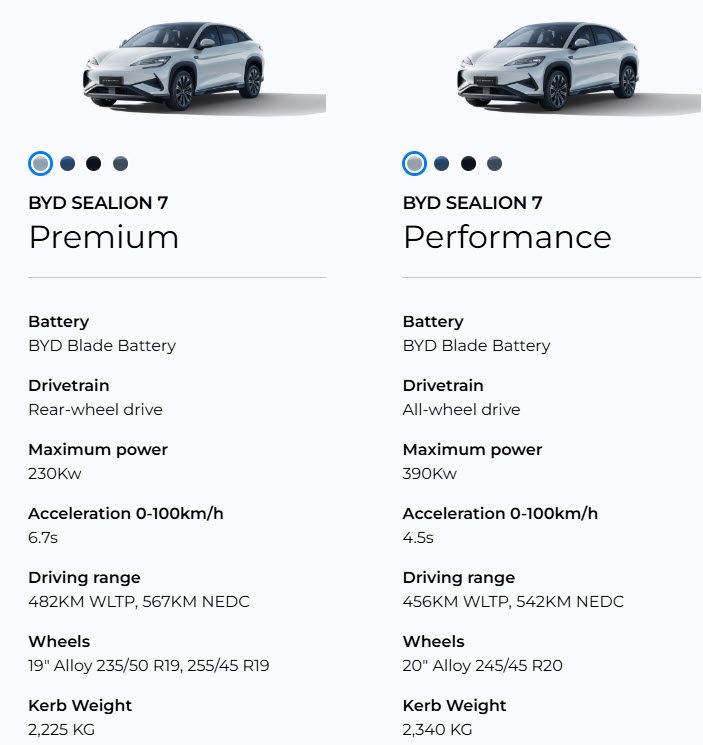

Given the entry-level model’s price of $54,990 before on-roads and with the incentives on offer, the upcoming approved for sale variant, could even possibly be offered under $50,000.
The current entry-level Sealion 7 Premium is powered by a single 230 kW rear-mounted motor, which delivers a 0-100 km/h acceleration time of 6.7 seconds.
Both Sealion 7 Premium and Performance variants are equipped with an 82.56 kWh Lithium Iron Phosphate (LFP) BYD blade battery pack, which is around 15% bigger than the one found in the approval documentation of the upcoming variant.
We look forward to seeing if and when this variant lands into the Sealion 7 line up, as it is likely to make a splash with value focused drivers, when it’s expected to land next year.


Riz is the founder of carloop based in Melbourne, specialising in Australian EV data, insight reports and trends. He is a mechanical engineer who spent the first 7 years of his career building transport infrastructure before starting carloop. He has a passion for cars, particularly EVs and wants to help reduce transport emissions in Australia. He currently drives a red Tesla Model 3.
